CUBE 01 · THE CORE
The memory core
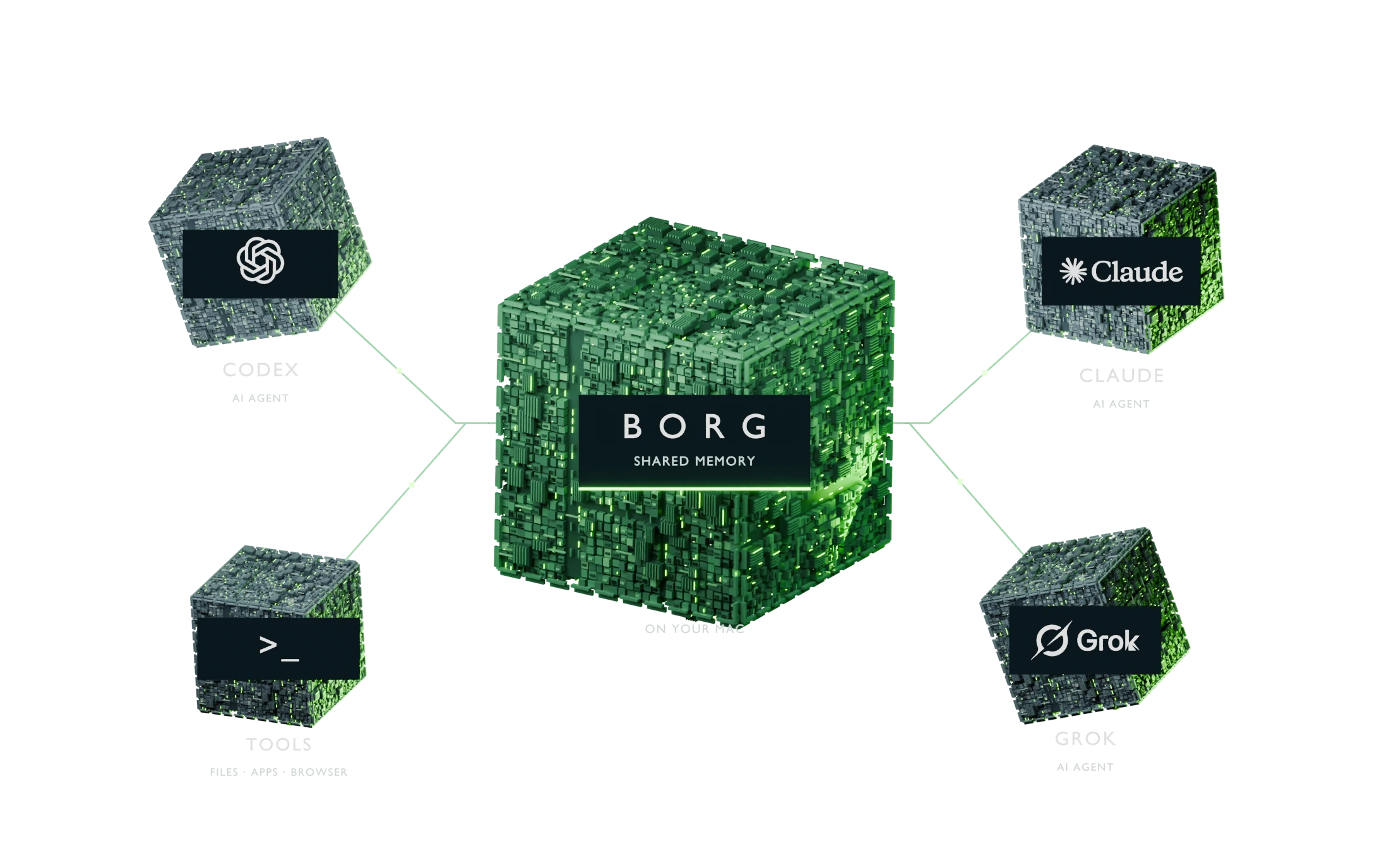
The collective’s shared memory.
- What it does
- Holds what the agents learn, in scopes: personal, team, operations and project. A local vector store finds notes by meaning, and a temporal graph keeps track of how facts connect over time. Agents write to it as they work and read from it before they answer.
- Why it exists
- So a lesson one agent learns on one studio doesn’t have to be learned again by every other agent the next morning.
≈122,000 memories, in four scopes
CUBE 02 · THE JUDGE
JEV, the judge
A small, fast model that makes narrow calls.
- What it does
- Answers narrow questions through a typed API, such as “is this a durable fact or a tool echo?” or “are these two notes the same fact?”, and returns a choice with its confidence. Every lane that uses it has a signed grant, a daily budget and pinned source hashes. Its receipts hold ids, hashes and counts, never memory text.
- Why it exists
- The big agents should spend their attention on the work, not on housekeeping. If JEV is unavailable, each lane falls back to its old behaviour: nothing breaks and nothing is lost.
5 lanes live, each with its own grant and budget
CUBE 03·1 · JEV LANE
Recall
Chooses what an agent sees before it answers.
- What it does
- Before an agent on the main studio answers, JEV ranks the memory candidates and picks what goes into its context.
- Why it exists
- An agent’s context is small. A few well-chosen memories help more than a pile of loosely related ones.
590 of 591 prompts where recall applied, over six hours
CUBE 03·2 · JEV LANE
The incoming filter
Judges new facts before they are stored.
- What it does
- Drops tool echoes and telemetry fragments before they reach memory. Each drop is first saved to an owner-only recovery copy. It ran for 24 hours in shadow first, judging everything and dropping nothing.
- Why it exists
- Keeping noise out of memory is cheaper, and safer, than cleaning it up later.
0 of 116 would-be drops were durable facts, all read by hand
CUBE 03·3 · JEV LANE
Dreaming
Tidies memory every night.
- What it does
- Retires duplicates with a reversible marker that recall honours. JEV must be at least 90% sure that two notes are the same fact. Chain protection keeps any note that another marker points to.
- Why it exists
- Memory that repeats itself crowds out what matters. Retiring instead of deleting means a mistake can always be put back.
≥90% sure, before two notes count as one fact
CUBE 03·4 · JEV LANE
Cache cleanup
Frees disk space every morning.
- What it does
- Picks disposable caches to quarantine: at most 5 units or 1 GiB a day. Nothing is purged for 7 days, and anything can be restored until then.
- Why it exists
- Agents fill disks with caches. A slow, reversible cleanup frees space without surprises.
7 days to change our minds before anything is purged
CUBE 03·5 · JEV LANE
Context packets
A starter kit for every job.
- What it does
- When an agent job starts, JEV assembles a small packet of the files most relevant to its brief. The original brief is kept exactly as written.
- Why it exists
- An agent that starts with the right files spends less time looking for them.
48 real jobs got packets on 25 September, every brief preserved byte for byte
CUBE 04 · ON DEMAND
Deep dream
A full clean-up pass, when we ask for one.
- What it does
- Goes through the whole memory: exact duplicates, near-duplicates judged by JEV, tool echoes and stale machine snapshots. One command restores a whole wave.
- Why it exists
- The nightly dream works on one day at a time. The deep dream catches what built up before.
3,133 memories retired by 09:36 on day one, checked by recall tests and payload snapshots
CUBE 05 · ALWAYS ON
The judge kit
Quality checks that run on their own.
- What it does
- Grades every hour whether recalled memories were actually used, and whether a “done”, “green” or “live” claim has evidence in the same turn. Guards every client message, so only orchestration-tier models can send. Stops a delegated brief that has no acceptance check, artifact or stop condition. Raises drift alarms every 15 minutes, and keeps an hourly routing scoreboard.
- Why it exists
- Agents can be confidently wrong. Quiet, constant checks catch it early, and the scoreboard feeds back into where the next agent runs.
6 always-on checks: two hooks guard sends and briefs, four run on a schedule
CUBE 06 · THE FLEET
The fleet
Seven Macs, called studios.
- What it does
- Runs agents from three providers, Claude, Codex and Grok, on seats and conductors. Work is placed by measured capacity, not guesswork. Agents message each other through an Inbox with signed authority grants, and track work in Beads, a shared task graph.
- Why it exists
- Many agents need one plan, and people need their own machines. One studio is held for the owner and takes no agent lanes.
7 studios and 3 providers, with 1 studio held for the owner
CUBE 07 · THE HULL
The rules
What makes the whole ship trustworthy.
- Reversible by default. Retire, quarantine and mark, rather than delete.
- Receipts without text. Ids, hashes and counts, never memory text.
- Fail open. If a check is down, fall back to the old behaviour.
- A budget and a grant for every model call.
- An independent code review before every change we install.
- An exact undo for every change we install.
6 rules that make the collective trustworthy